
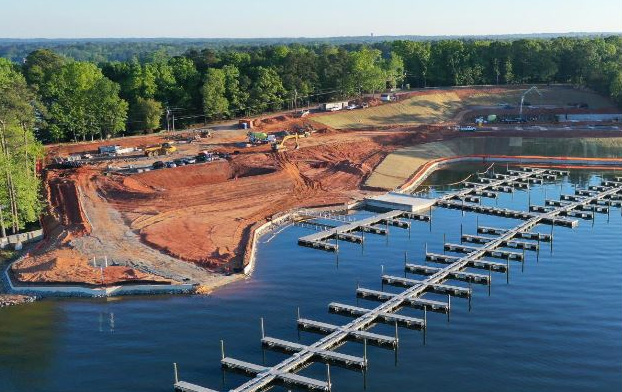
This concrete project involved the construction of various concrete elements for a marina. including sea walls, a boat launch bulkhead foundation, dry stack storage foundations, and heavy-duty paving. The project encompassed a total of 2,367 linear feet of walls, covering an area of nearly 50,o00 square feet. The project utilized 164,000 pounds of steel reinforcement and 3.277 cubic yards of concrete.
The project was divided into three phases.
Phase one focused on the work below the lake level and had to be completed quickly during the lake’s drawn-down phase, as per the permits issued to the owner. This phase involved mapping out the shoreline, establishing control points, and precisely laying out the walls according to the specifications provided by the Army Corps of Engineers.
Phase two involved constructing the dry-stack storage foundations, which had to be completed before the arrival of structural steel in early spring. These foundations were designed to support the weight of two 100,000-pound forklifts that would be used for placing boats in the water. The amount of rebar used in both the walls and cap slab was substantial.
Phase three focused on the heavy-duty paving to connect the warehouses to the boat launch bulkhead foundation. This paving played a crucial role, as the forklifts would be transporting boats along this stretch. Speed, efficiency, and accuracy were essential factors in all three phases of the project.
The project faced three main challenges: heavy rebar requirements, adverse weather conditions, and the lake level. The extensive rebar installation had to be completed within tight timeframes to overcome weather conditions. Unfavorable weather, including record rainfall, necessitated creative and quick solutions for each task. Additionally, the lake level had to reach a specific point before work could commence, and a cofferdam was installed for the foundation work below the lake level. Despite these challenges, Chapin Concrete successfully completed the project within the given timeline, finishing the work below the lake level just before the rising water breached the cofferdam.
